
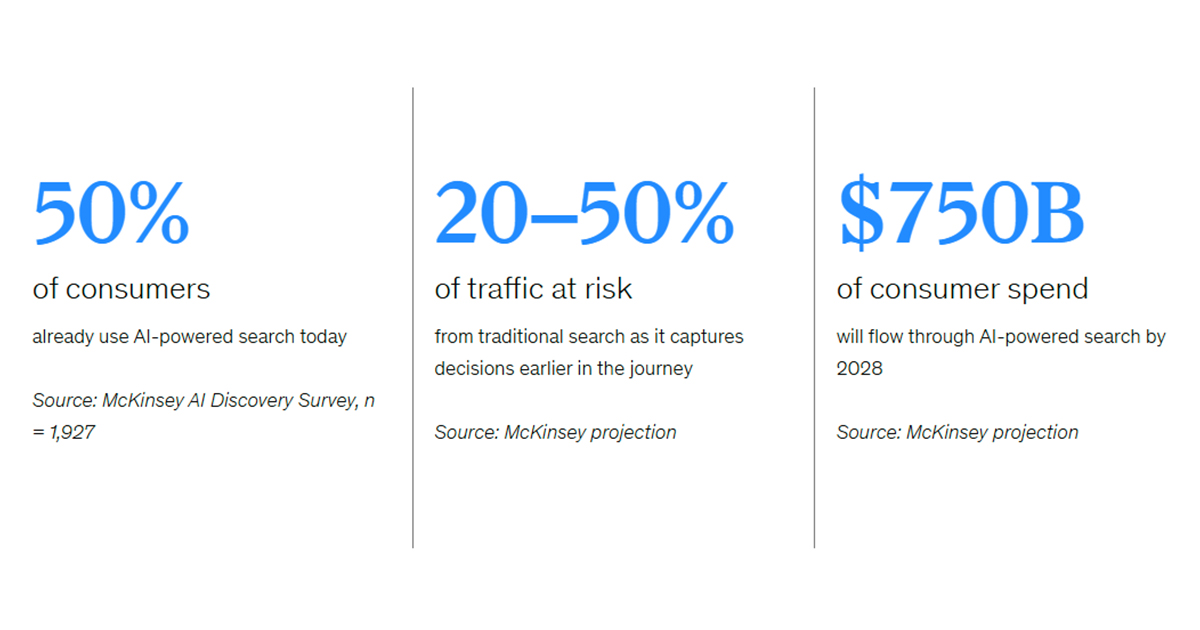
Are you still wondering when AI will change search results, discovery, and search patterns? Then, you are already too late! The internet as we know it is changing at an unfathomable speed. Right now, while you’re reading this, half of all consumers are already using AI-powered search to make purchasing decisions. If your business isn’t optimized for this new reality, you aren’t just slipping behind; you’ll be joining the echelons of has-beens! Before we dive into the complexities of AI SEO and why everyone has been talking about it, you have to understand that this isn’t a trend you can simply wait out. By 2028, a staggering $750 billion in consumer spending will flow through AI-powered search platforms. That’s not a prediction, it’s a wakeup call for all businesses. AI SEO and AI web browsers are a tidal wave of change that’s already building, and businesses that haven’t prepared will be swept away.
AI-SEO-2025
AI SEO, or AI Search Engine Optimization, represents the next evolution of digital marketing. Unlike traditional SEO, which focuses on optimizing your website for search engines like Google, AI SEO integrates machine learning, natural language processing (NLP), and large language models (LLMs) into every aspect of your search optimization strategy. You can think of it this way: traditional SEO was about getting your website to rank on page one. AI SEO is about making sure your brand is the answer AI systems provide when consumers ask questions.
This technology-driven approach enhances and automates critical SEO components, including keyword research, content creation, on-page optimization, technical SEO analysis, and continuous performance monitoring. However, here’s what makes it revolutionary: AI SEO doesn’t just react to changes; it predicts them and adapts in real-time and brings your content to audiences that you couldn’t reach before. With AI SEO, you get to tap into newer spaces, generate more leads, and drive better traffic to your websites.
According to HubSpot, 85% of marketers already believe generative AI will significantly impact content creation. The question isn’t whether AI will transform search as it already has. The question is whether your business will adapt in time or be left in the dust.
Traditional SEO was straightforward but limited. You’d identify high-volume keywords, sprinkle them throughout your content at specific densities, build backlinks, and wait to see your rankings improve. It was formulaic, reactive, and increasingly ineffective in today’s AI-driven landscape.
Are you thinking what’s the most significant difference? Google now uses over 200 ranking factors and makes thousands of algorithm adjustments annually. No human team can keep pace with this complexity. AI can and does, in real-time, without getting tired.
Now, this is the part where things get really interesting. We’re now seeing the emergence of Generative Engine Optimization (GEO). It is a discipline that focuses specifically on getting your content featured, cited, and referenced in AI-generated responses from systems, like ChatGPT, Claude, Gemini, and Google’s AI Overviews. The goal of GEO is to get your content selected as the authoritative source that informs AI responses. You’re no longer competing for clicks as you’re competing to be the voice of AI itself. Research from Princeton University, Georgia Tech, The Allen Institute for AI, and IIT Delhi found that implementing GEO methods like including citations, quotations from relevant sources, and statistics improves source visibility by over 40% in AI-generated responses.
Even more striking is that 44% of AI-powered search users now say it’s their primary and preferred source of insight. This completely surpasses traditional search at 31%, retailer or brand websites at 9%, and review sites at 6%. What this shift means couldn’t be more obvious. Your customers have already made the switch. Has your business?
We’re witnessing the emergence of an entirely new category: AI-powered browsers. Engines like ATLAS ChatGPT represent a fundamental shift in how people navigate the internet. These browsers, which include Perplexity Comet, are AI-first interfaces where search, browsing, and decision-making happen simultaneously through conversation. When someone uses ATLAS ChatGPT or Perplexity Comet, they’re not clicking through ten blue links to compare information. They’re having a conversation where the AI offers information from multiple sources instantly and provides comprehensive and personalized answers.
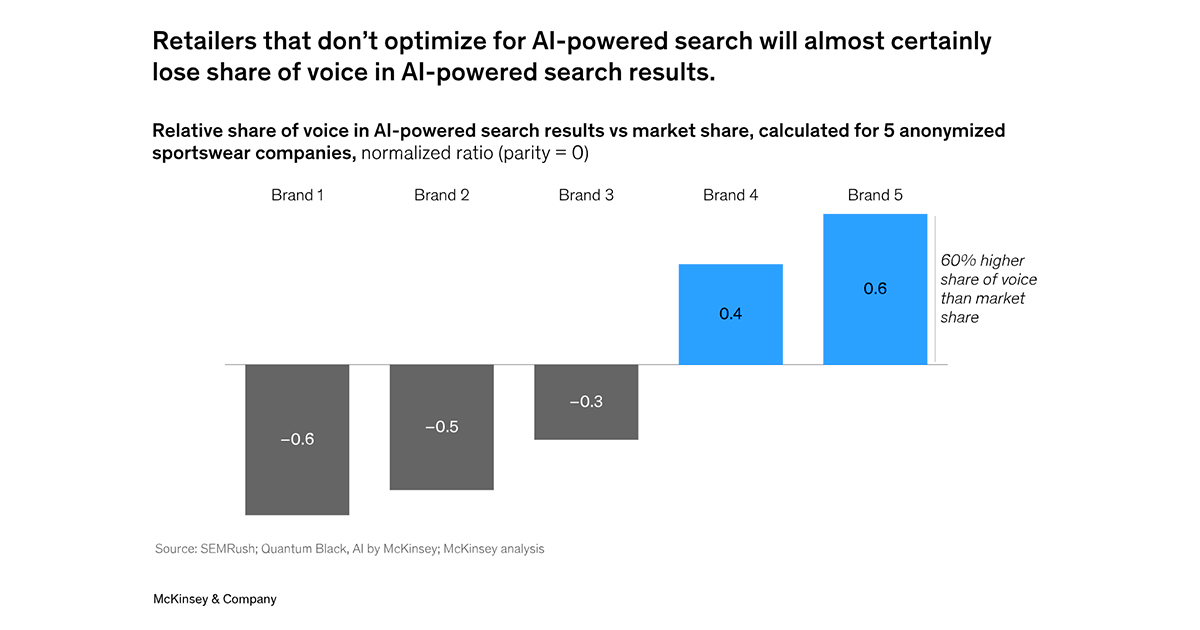
Currently, about half of Google searches display AI-powered summaries, but analysts predict that will grow to more than 75% by 2028. Your future customers will trust AI browsers instead of Google. If your content isn’t optimized for AI citation, you simply don’t exist in this new ecosystem. The data is sobering as brands may experience a decline in traffic from traditional search channels anywhere from 20 to 50 percent as AI-powered search captures decisions earlier in the journey. However, here’s what should really keep you up at night: Only about 5–10% of AI search sources come from brand websites. Even market leaders aren’t guaranteed visibility. Many top brands are frequently absent from AI-powered search platform answers as they are not AI SEO optimized yet.
AI search is quickly becoming the first place people look for answers. If your brand shows up there, you stay miles ahead of your competitors! With AI SEO, you get these irrefutable perks:
Here’s a shocker for you: according to a 2024 study by SparkToro, 58.5% of Google searches in the United States ended without a click. In the European Union, it’s even higher at 59.7%. Users are finding the information they need directly on the search results page through AI-generated answers, featured snippets, and knowledge panels. What does this mean for your business? Traditional metrics like organic traffic may decline even if you’re doing everything “right” by old standards.
There’s a silver lining, research from Amsive found that branded keywords are less likely to trigger AI Overviews, and when they do, they receive an 18.68% increase in click-through rate on average. This means that building a strong, AI-optimized brand presence pays dividends across both AI-generated results and traditional clicks. However, there’s a hurdle you have to clear; just 16% of brands today systematically track AI search performance. That means 84% of your potential competitors are flying blind, creating a massive opportunity for businesses that take action now.
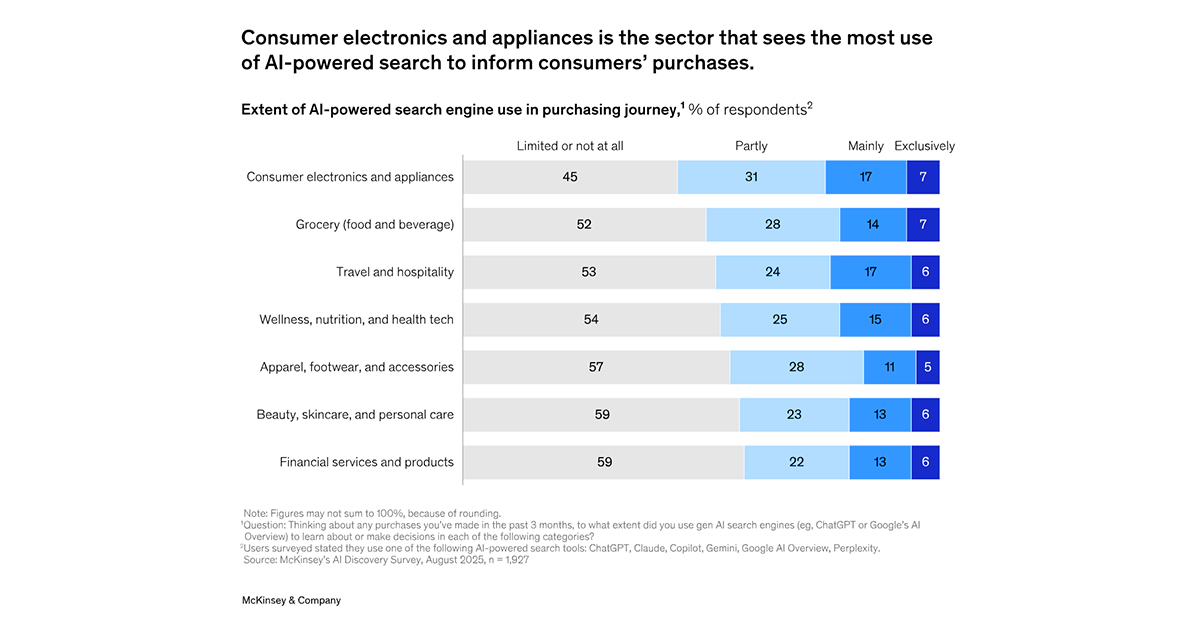
While AI-powered search affects every sector, some industries are experiencing faster transformation. In consumer-packaged goods and financial services, more than 65% of sources across AI-powered searches are publishers, user-generated content, and affiliate sites. Brand websites are no where to be seen in AI results. This means even if you have strong traditional SEO, you may be largely invisible in AI-powered search. Let’s consider the example of someone looking for a good pair of cross-training shoes and they want info on them. With AI-powered search, they instantly understand important factors, which brands offer what specific features, and which models have strong reviews. This information is now personalized to their training goals and budget. Basically, the consumer found everything that they wanted through AI search. Now, what’s going to happen? They make a purchasing decision without ever visiting your website. And there goes your leads, your sales, and your business is now in the red!
Moreover, sectors like travel, wellness, and consumer electronics are seeing similar patterns. Over 70% of AI-powered search users ask questions at the top of the funnel. They learn about a category, brand, product, or service under one search heading. While AI technology heavily influences your consumer’s entire decision journey.
The clock is ticking. By 2028, if current trends continue, businesses without AI SEO could see traffic declines of 20-50% from traditional search. Meanwhile, $750 billion in consumer spending will flow through AI-powered channels where they have no presence. Your competitors who invest in AI SEO now will establish authority signals that compound over time. They’ll be the brands AI systems learn to trust and cite. They’ll capture customers earlier in the decision journey, before those customers ever visit a traditional search engine.
The gap between AI-optimized businesses and everyone else will widen rapidly—not linearly, but exponentially. Every month you wait, the catch-up becomes harder and more expensive.
But here’s the opportunity: because only 16% of brands are systematically tracking and optimizing for AI search, we’re still in the early adopter phase. The businesses that move now will establish positions of authority that become increasingly difficult for later entrants to challenge.
The landscape has shifted, and the businesses that recognize this reality and take action now will dominate their markets for the next decade. However, you have to take into consideration that implementing comprehensive AI SEO requires specialized expertise, advanced tools, and constant adaptation as AI platforms evolve. That’s where we come in! At Digital Perfection, we understand both the technical requirements and the strategic positioning necessary to win in this new landscape. So, don’t let your competitors define the AI-powered future of your industry. Book a Free AI SEO Audit today and figure out where your business stands in AI-powered search. We’ll show you the gaps in your current approach, the opportunities you’re missing, and the specific steps we’ll take to establish your dominance in this new AI-centered era. The future of search is here! The only question is whether your business will lead it or be left behind by it. Let’s make sure you’re on the winning side.
Are you still wondering when AI will change search results, discovery, and search patterns? Then, you are already too late! The internet as we know it is changing at an unfathomable speed. Right now, while you’re reading this, half of all consumers are already using AI-powered search to make purchasing decisions. If your business isn’t optimized for this new reality, you aren’t just slipping behind; you’ll be joining the echelons of has-beens! Before we dive into the complexities of AI SEO and why everyone has been talking about it, you have to understand that this isn’t a trend you can simply wait out. By 2028, a staggering $750 billion in consumer spending will flow through AI-powered search platforms. That’s not a prediction, it’s a wakeup call for all businesses. AI SEO and AI web browsers are a tidal wave of change that’s already building, and businesses that haven’t prepared will be swept away.
AI-SEO-2025
AI SEO, or AI Search Engine Optimization, represents the next evolution of digital marketing. Unlike traditional SEO, which focuses on optimizing your website for search engines like Google, AI SEO integrates machine learning, natural language processing (NLP), and large language models (LLMs) into every aspect of your search optimization strategy. You can think of it this way: traditional SEO was about getting your website to rank on page one. AI SEO is about making sure your brand is the answer AI systems provide when consumers ask questions.
This technology-driven approach enhances and automates critical SEO components, including keyword research, content creation, on-page optimization, technical SEO analysis, and continuous performance monitoring. However, here’s what makes it revolutionary: AI SEO doesn’t just react to changes; it predicts them and adapts in real-time and brings your content to audiences that you couldn’t reach before. With AI SEO, you get to tap into newer spaces, generate more leads, and drive better traffic to your websites.
According to HubSpot, 85% of marketers already believe generative AI will significantly impact content creation. The question isn’t whether AI will transform search as it already has. The question is whether your business will adapt in time or be left in the dust.
Traditional SEO was straightforward but limited. You’d identify high-volume keywords, sprinkle them throughout your content at specific densities, build backlinks, and wait to see your rankings improve. It was formulaic, reactive, and increasingly ineffective in today’s AI-driven landscape.
Are you thinking what’s the most significant difference? Google now uses over 200 ranking factors and makes thousands of algorithm adjustments annually. No human team can keep pace with this complexity. AI can and does, in real-time, without getting tired.
Now, this is the part where things get really interesting. We’re now seeing the emergence of Generative Engine Optimization (GEO). It is a discipline that focuses specifically on getting your content featured, cited, and referenced in AI-generated responses from systems, like ChatGPT, Claude, Gemini, and Google’s AI Overviews. The goal of GEO is to get your content selected as the authoritative source that informs AI responses. You’re no longer competing for clicks as you’re competing to be the voice of AI itself. Research from Princeton University, Georgia Tech, The Allen Institute for AI, and IIT Delhi found that implementing GEO methods like including citations, quotations from relevant sources, and statistics improves source visibility by over 40% in AI-generated responses.
Even more striking is that 44% of AI-powered search users now say it’s their primary and preferred source of insight. This completely surpasses traditional search at 31%, retailer or brand websites at 9%, and review sites at 6%. What this shift means couldn’t be more obvious. Your customers have already made the switch. Has your business?
We’re witnessing the emergence of an entirely new category: AI-powered browsers. Engines like ATLAS ChatGPT represent a fundamental shift in how people navigate the internet. These browsers, which include Perplexity Comet, are AI-first interfaces where search, browsing, and decision-making happen simultaneously through conversation. When someone uses ATLAS ChatGPT or Perplexity Comet, they’re not clicking through ten blue links to compare information. They’re having a conversation where the AI offers information from multiple sources instantly and provides comprehensive and personalized answers.
Currently, about half of Google searches display AI-powered summaries, but analysts predict that will grow to more than 75% by 2028. Your future customers will trust AI browsers instead of Google. If your content isn’t optimized for AI citation, you simply don’t exist in this new ecosystem. The data is sobering as brands may experience a decline in traffic from traditional search channels anywhere from 20 to 50 percent as AI-powered search captures decisions earlier in the journey. However, here’s what should really keep you up at night: Only about 5–10% of AI search sources come from brand websites. Even market leaders aren’t guaranteed visibility. Many top brands are frequently absent from AI-powered search platform answers as they are not AI SEO optimized yet.
AI search is quickly becoming the first place people look for answers. If your brand shows up there, you stay miles ahead of your competitors! With AI SEO, you get these irrefutable perks:
Here’s a shocker for you: according to a 2024 study by SparkToro, 58.5% of Google searches in the United States ended without a click. In the European Union, it’s even higher at 59.7%. Users are finding the information they need directly on the search results page through AI-generated answers, featured snippets, and knowledge panels. What does this mean for your business? Traditional metrics like organic traffic may decline even if you’re doing everything “right” by old standards.
There’s a silver lining, research from Amsive found that branded keywords are less likely to trigger AI Overviews, and when they do, they receive an 18.68% increase in click-through rate on average. This means that building a strong, AI-optimized brand presence pays dividends across both AI-generated results and traditional clicks. However, there’s a hurdle you have to clear; just 16% of brands today systematically track AI search performance. That means 84% of your potential competitors are flying blind, creating a massive opportunity for businesses that take action now.
While AI-powered search affects every sector, some industries are experiencing faster transformation. In consumer-packaged goods and financial services, more than 65% of sources across AI-powered searches are publishers, user-generated content, and affiliate sites. Brand websites are no where to be seen in AI results. This means even if you have strong traditional SEO, you may be largely invisible in AI-powered search. Let’s consider the example of someone looking for a good pair of cross-training shoes and they want info on them. With AI-powered search, they instantly understand important factors, which brands offer what specific features, and which models have strong reviews. This information is now personalized to their training goals and budget. Basically, the consumer found everything that they wanted through AI search. Now, what’s going to happen? They make a purchasing decision without ever visiting your website. And there goes your leads, your sales, and your business is now in the red!
Moreover, sectors like travel, wellness, and consumer electronics are seeing similar patterns. Over 70% of AI-powered search users ask questions at the top of the funnel. They learn about a category, brand, product, or service under one search heading. While AI technology heavily influences your consumer’s entire decision journey.
The clock is ticking. By 2028, if current trends continue, businesses without AI SEO could see traffic declines of 20-50% from traditional search. Meanwhile, $750 billion in consumer spending will flow through AI-powered channels where they have no presence. Your competitors who invest in AI SEO now will establish authority signals that compound over time. They’ll be the brands AI systems learn to trust and cite. They’ll capture customers earlier in the decision journey, before those customers ever visit a traditional search engine.
The gap between AI-optimized businesses and everyone else will widen rapidly—not linearly, but exponentially. Every month you wait, the catch-up becomes harder and more expensive.
But here’s the opportunity: because only 16% of brands are systematically tracking and optimizing for AI search, we’re still in the early adopter phase. The businesses that move now will establish positions of authority that become increasingly difficult for later entrants to challenge.
The landscape has shifted, and the businesses that recognize this reality and take action now will dominate their markets for the next decade. However, you have to take into consideration that implementing comprehensive AI SEO requires specialized expertise, advanced tools, and constant adaptation as AI platforms evolve. That’s where we come in! At Digital Perfection, we understand both the technical requirements and the strategic positioning necessary to win in this new landscape. So, don’t let your competitors define the AI-powered future of your industry. Book a Free AI SEO Audit today and figure out where your business stands in AI-powered search. We’ll show you the gaps in your current approach, the opportunities you’re missing, and the specific steps we’ll take to establish your dominance in this new AI-centered era. The future of search is here! The only question is whether your business will lead it or be left behind by it. Let’s make sure you’re on the winning side.

